
&w=3840&q=75)
&w=3840&q=75)
&w=3840&q=75)
&w=3840&q=75)
&w=3840&q=75)
&w=3840&q=75)

267
SUMATRA, GRANDES ILES DE LA SONDE, INDONÉSIE. POPULATION BATAK, LAC TOBA F
The item was sold for 1 300 €
Fees include commission and taxes.
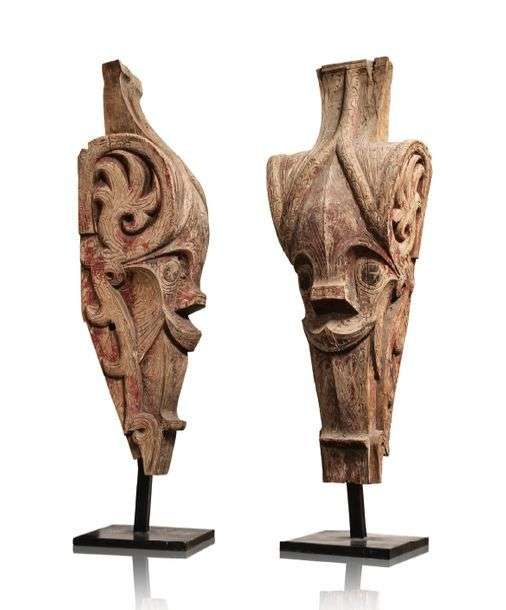
SUMATRA, GRANDES ILES DE LA SONDE, INDONÉSIE. POPULATION BATAK, LAC TOBA FIN XIXe-DÉBUT XXe SIÈCLE
Wooden Singas Singas with traces of polychromy.
The Batak of Sumatra originate from Lake
Toba, the centre of the world according to them, and the largest crater on earth.
The Singa has only the name lion (Singapore, the city of the lion). In the
Batak civilization it is the representation of the mythical snake buffalo that carries the world on its back and separates the lower world from the forces of the earth from the upper world of creation.
The Singa Singa (two singa in Indonesian) were the ornamental or frightening ends of the two horizontal beams more than ten metres long that supported the batak houses separating the lower part where the animals were located from the middle part devoted to the habitat, the roof representing the upper world and the house symbolising the tripartite microcosm.
H. 138 cm each
Wooden Singas Singas with traces of polychromy.
The Batak of Sumatra originate from Lake
Toba, the centre of the world according to them, and the largest crater on earth.
The Singa has only the name lion (Singapore, the city of the lion). In the
Batak civilization it is the representation of the mythical snake buffalo that carries the world on its back and separates the lower world from the forces of the earth from the upper world of creation.
The Singa Singa (two singa in Indonesian) were the ornamental or frightening ends of the two horizontal beams more than ten metres long that supported the batak houses separating the lower part where the animals were located from the middle part devoted to the habitat, the roof representing the upper world and the house symbolising the tripartite microcosm.
H. 138 cm each