
&w=3840&q=75)
&w=3840&q=75)
&w=3840&q=75)
&w=3840&q=75)
&w=3840&q=75)
&w=3840&q=75)


288
SAINT-EXUPÉRY (Antoine de)
The item was sold for 2 860 €
Fees include commission and taxes.
SAINT-EXUPÉRY (Antoine de)
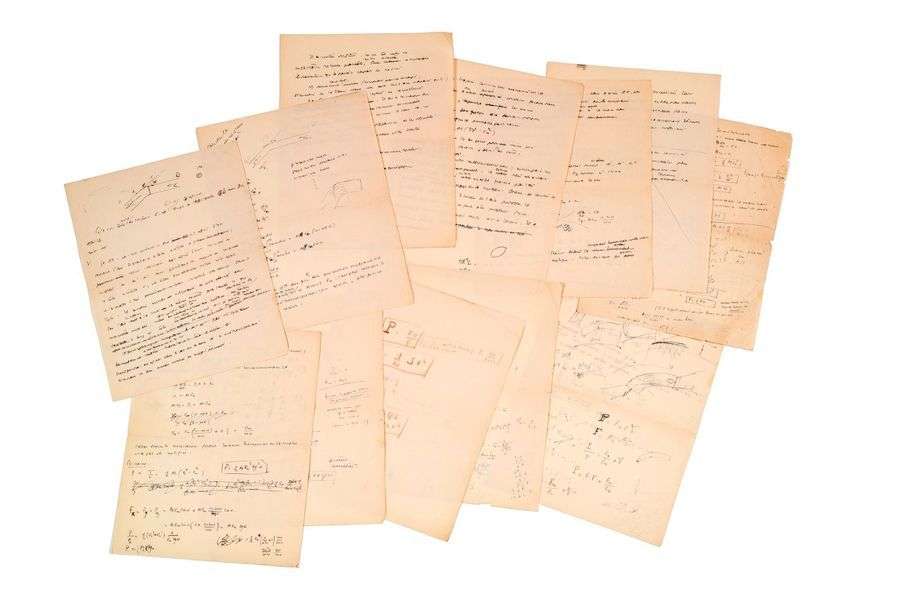
Autograph manuscript. With sketches. S.l.n.a. (c. 1937-1938). 15 pp. in-4, black ink, graphite and red pencil, erasures and corrections.
Long manuscript full of commented and annotated scientific drawings, calculations and equations. Saint-Exupéry has always invented new machines. As a child, he imagined a sailing bicycle and a steam sprinkler system. Later, he never stopped imagining other machines, notably at the Brest School of Navigation. From 1934 to 1940, he filed 13 patents, mainly in the aviation field: Aircraft landing device, Goniograph, Repeater system for reading indicating or measuring devices, Lifting and propulsion system, especially for aircraft, Route plotting device, especially for ships or aircraft, New method of location by electromagnetic waves, etc.. His inventions are mainly aimed at improving piloting or ensuring more precise air navigation. None of them will give rise to
industrial
development
.
The manuscript which interests us particularly here is partly composed of drafts, of tests not definitive but which tend to the realization of the Patent nº 850.093 "System of sustentation and propulsion, in particular for aircrafts" Deposited on August 17, 1938. Published September 4, 1939. "Either a bent S-section tube... Let W be the angle of the segment AB with CD with BC ". "I say-and this is obvious-that the effects of an air current passing through the tube at velocity V (working force...) are identical to the effects of a succession of masses U U' U'' etc penetrating the tube at velocity V from second to second, and such that each of them is equal to the mass of air (penetrating the tube) introduced per second into the tube. The necessary and sufficient condition of this data is that the air is kept at the outlet at the same speed as at the inlet, which may require, but will not change the problem without changing any data, variations of ? variables along the tube. The variations of a difference in data thus of
Autograph manuscript. With sketches. S.l.n.a. (c. 1937-1938). 15 pp. in-4, black ink, graphite and red pencil, erasures and corrections.
Long manuscript full of commented and annotated scientific drawings, calculations and equations. Saint-Exupéry has always invented new machines. As a child, he imagined a sailing bicycle and a steam sprinkler system. Later, he never stopped imagining other machines, notably at the Brest School of Navigation. From 1934 to 1940, he filed 13 patents, mainly in the aviation field: Aircraft landing device, Goniograph, Repeater system for reading indicating or measuring devices, Lifting and propulsion system, especially for aircraft, Route plotting device, especially for ships or aircraft, New method of location by electromagnetic waves, etc.. His inventions are mainly aimed at improving piloting or ensuring more precise air navigation. None of them will give rise to
industrial
development
.
The manuscript which interests us particularly here is partly composed of drafts, of tests not definitive but which tend to the realization of the Patent nº 850.093 "System of sustentation and propulsion, in particular for aircrafts" Deposited on August 17, 1938. Published September 4, 1939. "Either a bent S-section tube... Let W be the angle of the segment AB with CD with BC ". "I say-and this is obvious-that the effects of an air current passing through the tube at velocity V (working force...) are identical to the effects of a succession of masses U U' U'' etc penetrating the tube at velocity V from second to second, and such that each of them is equal to the mass of air (penetrating the tube) introduced per second into the tube. The necessary and sufficient condition of this data is that the air is kept at the outlet at the same speed as at the inlet, which may require, but will not change the problem without changing any data, variations of ? variables along the tube. The variations of a difference in data thus of