
&w=3840&q=75)
&w=3840&q=75)
&w=3840&q=75)
&w=3840&q=75)
&w=3840&q=75)
&w=3840&q=75)

213
[MANUSCRIT]. [GUICHE (Duchesse de].
The item was sold for 910 €
Fees include commission and taxes.
[MANUSCRIT]. [GUICHE (Duchesse de].
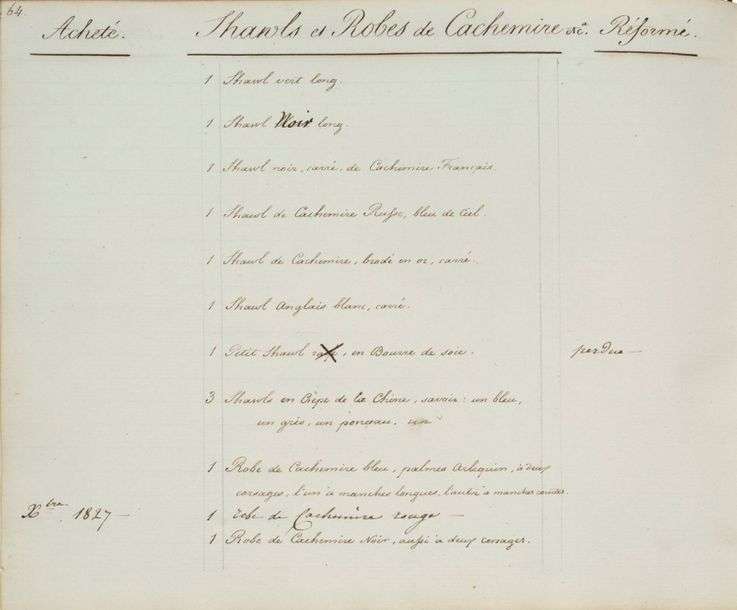
States. Her ladyship's wardrobe. Linen of the House. Etat des effets composant la garde-robe de Mme la duchesse de Guiche au 1er juillet 1826En
français, manuscript
on paperFrance,
1826 with additions until 1834In-4 oblong, 148 pp. (149 numbered but incomplete, pp. 115 to 120, 131 to 134, and 139 to 142 have been torn out), text in French in brown ink on paper. Bound in Russian half leather binding, boards covered with green paper with title on a label glued on the top cover (flattened caps, blunt corners, skins on the boards, freckles on p. 1 not altering the text). Dimensions:
212 x 265 mm.
This inventory of all the toilets of the Duchess of Guiche, as well as the household linen, takes us into the intimacy of a quality residence under the Restoration and the July Monarchy. The Count of Marcellus will evoke the beauty of the duchess in Chateaubriand et son temps (1859, p. 453): "Her braids, in fact, did not allow one to admire in all their beauty and abundance the hair of the Duchess of Guiche. In 1814, I had seen them wandering more freely on her teenage shoulders one day when Mademoiselle Ida d'Orsay was attending a review of the royal guard. [...]». Its toilets of all circumstances are made of the most beautiful fabrics of the time, notably cashmere, the emblematic "shawl" of the 19th
century.
Antoine IX Héraclius-Agénor de Gramont (1789-1855), Duke of Guiche married in 1818 Anna-Quintina-Albertine, known as Ida Grimod d'Orsay (1802-1882), then Duchess of Guiche, daughter of General Jean François Albert Grimod d'Orsay, and sister of the artist Alfred d'Orsay. In 1830, the Duc de Guiche sided with the Duc d'Angoulême. In 1833, the Duke returned to France and settled in Versailles. He took the title and the name of Duke of Gramont on the death of his father
(1836).
Annotations and corrections made to the inventory throughout the years up to 1834 in order to update it. Signature of the Du
States. Her ladyship's wardrobe. Linen of the House. Etat des effets composant la garde-robe de Mme la duchesse de Guiche au 1er juillet 1826En
français, manuscript
on paperFrance,
1826 with additions until 1834In-4 oblong, 148 pp. (149 numbered but incomplete, pp. 115 to 120, 131 to 134, and 139 to 142 have been torn out), text in French in brown ink on paper. Bound in Russian half leather binding, boards covered with green paper with title on a label glued on the top cover (flattened caps, blunt corners, skins on the boards, freckles on p. 1 not altering the text). Dimensions:
212 x 265 mm.
This inventory of all the toilets of the Duchess of Guiche, as well as the household linen, takes us into the intimacy of a quality residence under the Restoration and the July Monarchy. The Count of Marcellus will evoke the beauty of the duchess in Chateaubriand et son temps (1859, p. 453): "Her braids, in fact, did not allow one to admire in all their beauty and abundance the hair of the Duchess of Guiche. In 1814, I had seen them wandering more freely on her teenage shoulders one day when Mademoiselle Ida d'Orsay was attending a review of the royal guard. [...]». Its toilets of all circumstances are made of the most beautiful fabrics of the time, notably cashmere, the emblematic "shawl" of the 19th
century.
Antoine IX Héraclius-Agénor de Gramont (1789-1855), Duke of Guiche married in 1818 Anna-Quintina-Albertine, known as Ida Grimod d'Orsay (1802-1882), then Duchess of Guiche, daughter of General Jean François Albert Grimod d'Orsay, and sister of the artist Alfred d'Orsay. In 1830, the Duc de Guiche sided with the Duc d'Angoulême. In 1833, the Duke returned to France and settled in Versailles. He took the title and the name of Duke of Gramont on the death of his father
(1836).
Annotations and corrections made to the inventory throughout the years up to 1834 in order to update it. Signature of the Du