
&w=3840&q=75)
&w=3840&q=75)
&w=3840&q=75)
&w=3840&q=75)
&w=3840&q=75)
&w=3840&q=75)


ROSTAND (Edmond)
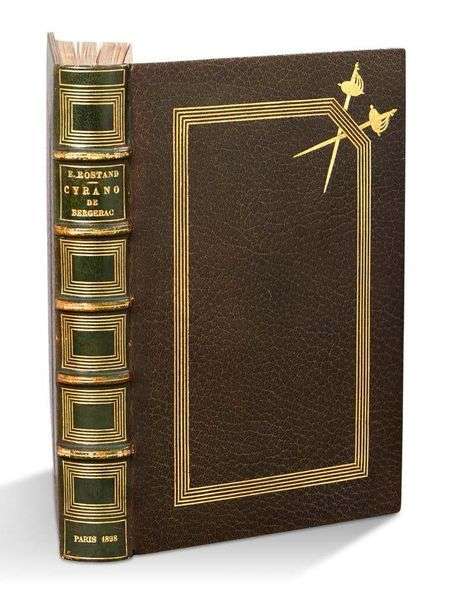
Cyrano de Bergerac. Heroic comedy in five acts in verse, performed in Paris at the Théâtre de la Porte Saint-Martin on December 28, 1897. Paris, Charpentier and Fasquelle, 1898. In-8, full green morocco, dishes decorated with a frame centred on five gold fillets, the upper outer corner of which is broken and bears a set of crossed and gilt swords, spine ribbed, double fillet on the cups, inner frame of the same morocco decorated with a gilt garland of grapes and vine leaves, inner fillet, gilt edges on witnesses, preserved green covers, case lined with the same morocco (Binding Pétrus Ruban dated 1898).
Original edition, one of the 5 nominative copies printed on pink paper, after 2 copies on calfskin, one reserved for the author, the other for the publisher and before 50 copies on Japan.
The
copy is hand-justified by the publisher Fasquelle, who added, under his handsigned dispatch to Angelo Mariani, the words "5 copies on
pink
paper/E
.F.".
The author has also enriched the present volume with two signed autographs, taken from the famous presentation of the cadets of Gascony by Cyrano to Monsieur de Guiche (Act II, scene VII): "These are the cadets of Gascony/De Charbon de Castel-Jaloux
...".
Copy printed especially for the famous pharmacist Angelo Mariani, with an autograph double shipment signed by the publisher Fasquelle and including the author "A Mariani of which I always have a bottle on my work table. Edmond Rostand". The pharmacist Angelo Mariani, the famous inventor of the "quinquina Mariani" (whose "bottle" mentioned by Rostand was presumably one of them), was also the publisher of iconographic albums and illustrated books, whose illustrations were systematically entrusted to his great friend Albert Robida: The Good Goddess of Poverty, by George Sand (1906), Three Wives for a Husband by Louis Vossion (1910) and Two Visions by Jules Claretie
(1910).
Copy enriched with 25 very fine o
LIV2021
Cyrano de Bergerac. Heroic comedy in five acts in verse, performed in Paris at the Théâtre de la Porte Saint-Martin on December 28, 1897. Paris, Charpentier and Fasquelle, 1898. In-8, full green morocco, dishes decorated with a frame centred on five gold fillets, the upper outer corner of which is broken and bears a set of crossed and gilt swords, spine ribbed, double fillet on the cups, inner frame of the same morocco decorated with a gilt garland of grapes and vine leaves, inner fillet, gilt edges on witnesses, preserved green covers, case lined with the same morocco (Binding Pétrus Ruban dated 1898).
Original edition, one of the 5 nominative copies printed on pink paper, after 2 copies on calfskin, one reserved for the author, the other for the publisher and before 50 copies on Japan.
The
copy is hand-justified by the publisher Fasquelle, who added, under his handsigned dispatch to Angelo Mariani, the words "5 copies on
pink
paper/E
.F.".
The author has also enriched the present volume with two signed autographs, taken from the famous presentation of the cadets of Gascony by Cyrano to Monsieur de Guiche (Act II, scene VII): "These are the cadets of Gascony/De Charbon de Castel-Jaloux
...".
Copy printed especially for the famous pharmacist Angelo Mariani, with an autograph double shipment signed by the publisher Fasquelle and including the author "A Mariani of which I always have a bottle on my work table. Edmond Rostand". The pharmacist Angelo Mariani, the famous inventor of the "quinquina Mariani" (whose "bottle" mentioned by Rostand was presumably one of them), was also the publisher of iconographic albums and illustrated books, whose illustrations were systematically entrusted to his great friend Albert Robida: The Good Goddess of Poverty, by George Sand (1906), Three Wives for a Husband by Louis Vossion (1910) and Two Visions by Jules Claretie
(1910).
Copy enriched with 25 very fine o
LIV2021