
&w=3840&q=75)
&w=3840&q=75)
&w=3840&q=75)
&w=3840&q=75)
&w=3840&q=75)
&w=3840&q=75)
&w=3840&q=75)
&w=3840&q=75)

114
ROUSSEAU (Jean-Jacques)
The item was sold for 872 €
Fees include commission and taxes.
ROUSSEAU (Jean-Jacques)
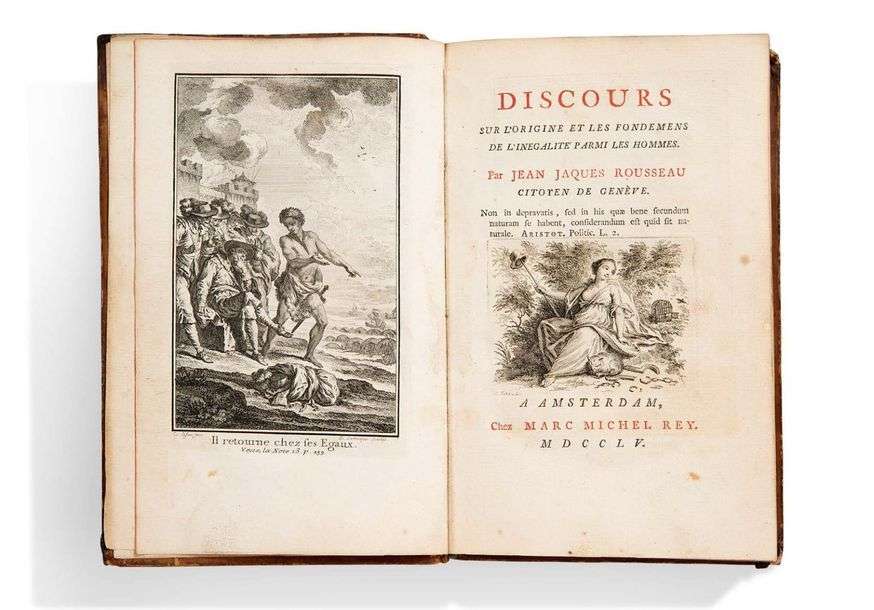
Discourse on the Origin and Foundations of Inequality among Men. Amsterdam, Marc Michel Rey, 1755. In-8, full marbled calf, smooth spine with gold fleurons, gilt title on spine, red edges (contemporary binding).
Original edition of one of the founding texts of modern political philosophical thought. Copy
on strong paper.
After a first brilliant answer in 1750, in his speech on the Action of Sciences and Arts on Morals, Rousseau wrote in 1753, a synthesis of his theories in order to provide an answer to the question asked by the Academy of Dijon "What is the origin of inequality among men, & if it is authorized by
the natural Loy."A
true reflection of his convictions, Rousseau sets out his vision of man and the world with the strong idea that society, based on property, is the cause of inequality and human corruption. It tends to show that ownership and greed drive man away from his true nature and that unless he returns to primitive innocence, he will become his own source of misfortune and decadence. "The first one who enclosed a piece of land, thought to say this is mine & found people simple enough to believe it, was the true founder of
civil
society
." (p.95
)The engraving in frontispiece, signed Eisen, illustrates perfectly the paradox of this education which tends to regression: a savage man, after having received a complete education, returns to his equals. He leaves the society of policemen, renounces the Christian religion, returns his rich clothes to put on a sheepskin and rediscover the manners and customs of his
ancestors.
Rousseau presents here for the first time his complete vision of man and the world, and overturns the political philosophy of his century and that of his contemporaries, raising controversies, notably on the part of Voltaire, who replied to him in a letter in 1755: "Never before has so much spirit been used to try to make us stupid. He ge
Discourse on the Origin and Foundations of Inequality among Men. Amsterdam, Marc Michel Rey, 1755. In-8, full marbled calf, smooth spine with gold fleurons, gilt title on spine, red edges (contemporary binding).
Original edition of one of the founding texts of modern political philosophical thought. Copy
on strong paper.
After a first brilliant answer in 1750, in his speech on the Action of Sciences and Arts on Morals, Rousseau wrote in 1753, a synthesis of his theories in order to provide an answer to the question asked by the Academy of Dijon "What is the origin of inequality among men, & if it is authorized by
the natural Loy."A
true reflection of his convictions, Rousseau sets out his vision of man and the world with the strong idea that society, based on property, is the cause of inequality and human corruption. It tends to show that ownership and greed drive man away from his true nature and that unless he returns to primitive innocence, he will become his own source of misfortune and decadence. "The first one who enclosed a piece of land, thought to say this is mine & found people simple enough to believe it, was the true founder of
civil
society
." (p.95
)The engraving in frontispiece, signed Eisen, illustrates perfectly the paradox of this education which tends to regression: a savage man, after having received a complete education, returns to his equals. He leaves the society of policemen, renounces the Christian religion, returns his rich clothes to put on a sheepskin and rediscover the manners and customs of his
ancestors.
Rousseau presents here for the first time his complete vision of man and the world, and overturns the political philosophy of his century and that of his contemporaries, raising controversies, notably on the part of Voltaire, who replied to him in a letter in 1755: "Never before has so much spirit been used to try to make us stupid. He ge