
&w=3840&q=75)
&w=3840&q=75)
&w=3840&q=75)
&w=3840&q=75)
&w=3840&q=75)
&w=3840&q=75)
&w=3840&q=75)
&w=3840&q=75)

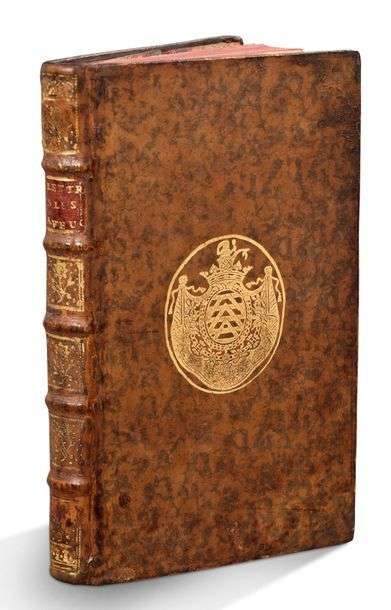
DIDEROT (Denis)
Letter on the blind for the use of those who see. London, [Paris, Durant], 1749. Small in-8, marbled calf, spine ribbed and decorated with red morocco title coin, gilt arms in the center of the plates, decorated cups, red edges (contemporary binding).
Genuine first edition as described by David Adams. It differs from the three other impressions or forgeries with the same vintage (Adams, Bibliographie des oeuvres de D. Diderot II, 2000, pp. 215-218-Tchemerzine II, pp. 924-925| figure III for the title and not figure IV as
mistakenly stated).
Laurent Durant was one of the most important French booksellers of the 18th century. Alone or in collaboration, he published hundreds of works during his career such as the Encyclopedia, a great classic of the Enlightenment.
In addition,
he was the main editor of Diderot with whom he
developed a deep friendship.
In 1749, three works by Diderot, including La Lettre sur les aveugles, for the use of those who see, were published without government approval or permission. The title page indicates London as the place of publication but does not mention the author
or publisher.
The Letter on the Blind challenged the "evidence" of those who see and the proof of the existence of God through the beauty of Creation. The blind man became the image of a thinker reduced to the trial and error of experience and hypothesis. Diderot embarked on daring philosophical speculations after many observations and experiments. He wondered about the psychology of the blind and their perception of the world in order to formulate intuitions: emergence of a sixth sense, sensitivity and energy of matter, notion of evolution where chance played a role... All this led to a scepticism close to atheism and
materialism.
His work not only printed clandestinely, caused a scandal and Diderot was imprisoned for three months in the dungeon of Vincennes, on a letter stamped by t
Letter on the blind for the use of those who see. London, [Paris, Durant], 1749. Small in-8, marbled calf, spine ribbed and decorated with red morocco title coin, gilt arms in the center of the plates, decorated cups, red edges (contemporary binding).
Genuine first edition as described by David Adams. It differs from the three other impressions or forgeries with the same vintage (Adams, Bibliographie des oeuvres de D. Diderot II, 2000, pp. 215-218-Tchemerzine II, pp. 924-925| figure III for the title and not figure IV as
mistakenly stated).
Laurent Durant was one of the most important French booksellers of the 18th century. Alone or in collaboration, he published hundreds of works during his career such as the Encyclopedia, a great classic of the Enlightenment.
In addition,
he was the main editor of Diderot with whom he
developed a deep friendship.
In 1749, three works by Diderot, including La Lettre sur les aveugles, for the use of those who see, were published without government approval or permission. The title page indicates London as the place of publication but does not mention the author
or publisher.
The Letter on the Blind challenged the "evidence" of those who see and the proof of the existence of God through the beauty of Creation. The blind man became the image of a thinker reduced to the trial and error of experience and hypothesis. Diderot embarked on daring philosophical speculations after many observations and experiments. He wondered about the psychology of the blind and their perception of the world in order to formulate intuitions: emergence of a sixth sense, sensitivity and energy of matter, notion of evolution where chance played a role... All this led to a scepticism close to atheism and
materialism.
His work not only printed clandestinely, caused a scandal and Diderot was imprisoned for three months in the dungeon of Vincennes, on a letter stamped by t